
Why Cricket Data Matters
Cricket is a sport where a single over, partnership or bowling spell can change the direction of a match. While the live score provides the immediate situation, statistics offer a deeper explanation of what is happening on the field.
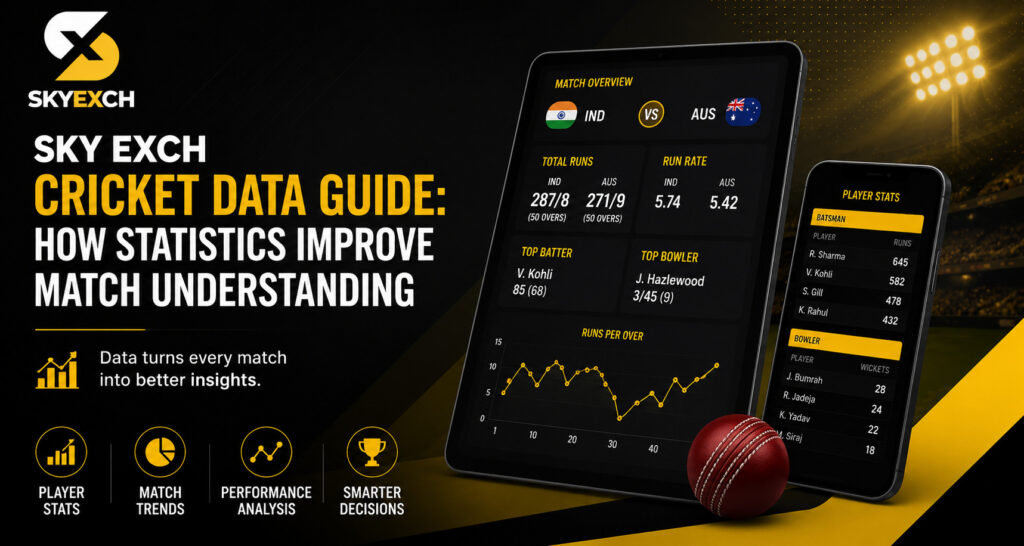
Cricket data includes batting figures, bowling numbers, team totals, partnerships, run rates and historical performances. Understanding these numbers can help fans follow matches with greater context rather than relying only on the scoreboard.
For anyone using a Sky Exch Cricket Data Guide as a learning resource, the main objective should be understanding how different statistics connect with match situations.
The Most Important Cricket Statistics
A cricket scorecard contains several statistics, but some are particularly useful for understanding performance.
Important figures include:
- Total runs
- Wickets lost
- Overs completed
- Run rate
- Strike rate
- Batting average
- Bowling economy
- Wickets taken
- Partnership runs
Each statistic answers a different question about a player’s or team’s performance.
Understanding Run Rate
Run rate measures how quickly a team is scoring.
In limited-overs cricket, run rate becomes especially important because teams have a fixed number of deliveries available. A team scoring quickly during the powerplay can create a strong foundation for the middle overs.
However, run rate should always be considered alongside wickets. A high scoring rate with several wickets lost may create a different match situation from a moderate scoring rate with most wickets still available.
Why Strike Rate Matters
Strike rate is particularly useful in T20 and ODI cricket.
It helps explain how quickly a batter scores compared with the number of deliveries faced. A batter who scores quickly can change the pressure on the opposition, especially during the middle and final overs.
Strike rate becomes more meaningful when considered alongside:
- Runs scored
- Balls faced
- Match situation
- Required run rate
- Wickets remaining
This prevents one statistic from being interpreted without context.
Understanding Bowling Economy
Bowling economy measures how many runs a bowler concedes per over.
A low economy rate can indicate effective control, while an expensive spell may increase pressure on the fielding team.
However, economy should not be viewed alone. A bowler might concede runs while taking important wickets, making the overall contribution more complicated than one number suggests.
Partnerships Can Reveal Match Momentum
Partnership statistics show how effectively two batters have worked together.
A strong partnership can:
- Stabilise an innings
- Recover from early wickets
- Increase the team’s total
- Reduce pressure on incoming batters
- Change the balance of a match
For this reason, partnership data is often useful when reviewing why an innings moved from a difficult position to a competitive one.
How Bowling Figures Explain Pressure
Bowling figures provide information about the effectiveness of a team’s attack.
A typical bowling card shows:
- Overs bowled
- Maidens
- Runs conceded
- Wickets
- Economy rate
Comparing these numbers across bowlers can show which players controlled scoring and which ones created breakthroughs.
Using Data Without Ignoring Match Context
Statistics are valuable, but they should not be considered in isolation.
Pitch conditions, weather, venue dimensions, opposition quality and match format can all influence performance.
For example, a particular run total might be excellent on a difficult pitch but relatively ordinary on a flat batting surface. Context gives statistics their proper meaning.
How Cricket Data Supports Better Match Analysis
A combination of live scores and statistics can provide a clearer picture of a match.
Fans can examine:
- Current score
- Recent scoring rate
- Wickets remaining
- Batting partnerships
- Bowling performance
- Required run rate
- Previous player performances
This creates a more complete understanding of the contest.
Key Takeaways
- Cricket statistics provide context beyond the live score.
- Run rate helps measure scoring speed.
- Strike rate explains batting tempo.
- Economy rate indicates bowling control.
- Partnerships can reveal changes in momentum.
- Statistics should always be considered alongside match conditions.
Frequently Asked Questions
What are the most important cricket statistics?
Runs, wickets, run rate, strike rate, batting average, bowling economy and partnerships are among the most useful statistics.
Why is cricket match analysis important?
Analysis helps fans understand how individual performances and team strategies influence the direction of a match.
What does bowling economy mean?
Bowling economy indicates the average number of runs a bowler concedes per over.
Why should statistics be considered with context?
Pitch, weather, opposition and match format can significantly influence statistical performance.